Short. Sharp. Powerful.
Few letters cause as much confusion as K in text messages.
You’ve seen it
You’ve sent it
You’ve probably overthought it
This guide breaks down the true meaning of K in text, without fluff or guesswork. You’ll learn what it actually signals, how tone shifts by context, and when you should worry. Or not worry at all.
Everything here stays simple, practical, and real.
Definition of K Meaning in Text
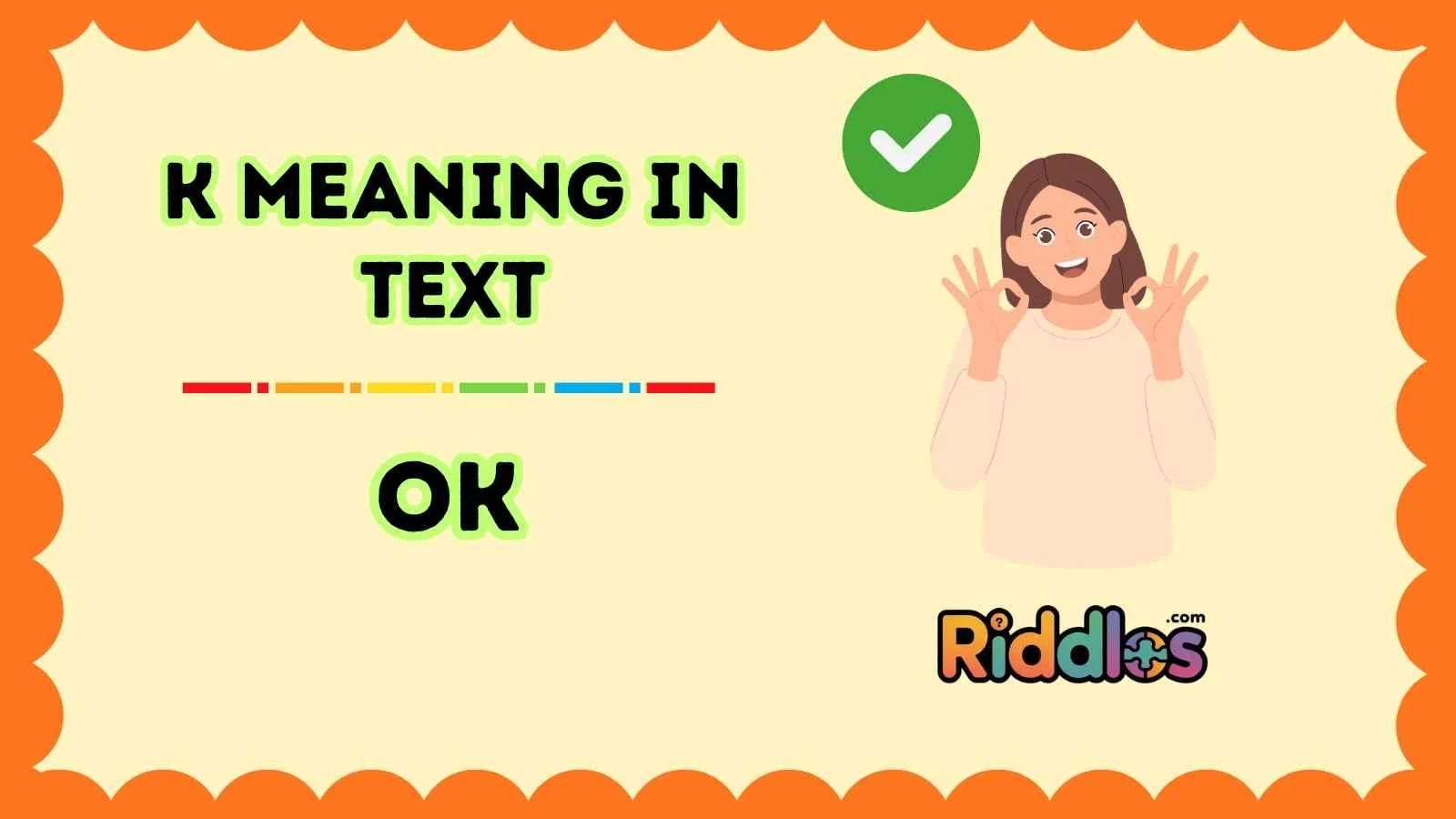
K is a shortened form of OK used in text messages and online chats.
At its core, K means acknowledgment.
Nothing more. Nothing less.
However, texting strips away tone, facial cues, and voice inflection. That’s why K meaning in text depends heavily on context.
In plain terms:
- K = I received your message
- K = I acknowledge
- K = I’m done with this topic
The meaning shifts based on who sent it, when they sent it, and what came before it.
Emotional Tone Behind “K” in Text Messages
This is where confusion starts.
The word K itself is neutral, but humans assign emotion to brevity.
Common emotional tones associated with K
- Neutral acknowledgment
“Dinner at 8?”
“K” - Dismissive or cold
Long message sent.
Reply received: “K” - Passive-aggressive
Appears during arguments or tense exchanges - Emotionally closed
Signals withdrawal or disengagement
Why K feels colder than OK
Length softens tone.
Short replies feel abrupt.
Compare these:
| Reply | Emotional Perception |
|---|---|
| Okay | Calm, agreeable |
| Ok | Neutral |
| K | Cold or distant |
Humans expect effort.
Minimal effort reads as minimal interest.
Origin and Evolution of “K” in Digital Communication
K didn’t start as rude.
It started as efficient.
How K evolved
- SMS character limits encouraged shorter replies
- Early chat rooms rewarded speed
- Typing culture favored minimalism
OK became Ok.
Ok became K.
Over time, cultural meaning attached itself to brevity.
What saved time began signaling emotional distance.
Language evolves.
Tone evolves with it.
How “K” Is Commonly Used in Texting Today
People use K in text for several real reasons.
Common uses
- Acknowledging information
- Ending a conversation quickly
- Responding while busy
- Avoiding emotional engagement
When K is harmless
- Logistics
- Schedules
- Confirmations
Example:
“Meeting moved to 3 PM.”
“K”
That’s functional.
No hidden message.
K Meaning Based on Conversation Context
Context decides everything.
K after a long message
This is where frustration appears.
You explain.
You vent
You open up
Response: K
This often feels dismissive because:
- Emotional effort wasn’t matched
- No validation was given
K during conflict
In arguments, K often signals shutdown.
It can mean:
- I don’t want to argue
- I’m annoyed
- I’m done talking
Repeated use of K
Repeated K responses usually indicate:
- Loss of interest
- Emotional distance
- Passive disengagement
Pattern matters more than one message.
K Meaning in Relationships and Friendships
Relationships amplify tone sensitivity.
Romantic relationships
In dating or partnerships, K often triggers overthinking.
Why?
Because partners expect warmth and reassurance.
K may signal:
- Emotional withdrawal
- Silent frustration
- Temporary annoyance
Friendships
Friends may use K casually without intent.
Close friends often know each other’s texting habits.
Strangers don’t.
History shapes meaning.
K Meaning in Dating Apps and Online Chats
Dating apps magnify short replies.
Why K feels worse on dating apps
- High competition
- Low attention spans
- Texting equals interest
If someone replies with K on a dating app, it often means:
- Low interest
- Polite disengagement
- Conversation closure
Is K always a red flag?
No.
But it’s usually a yellow light.
Watch what comes next.
Professional vs Casual Use of “K”
Workplace communication changes everything.
Why K feels unprofessional
Professional settings value clarity and courtesy.
K can appear:
- Dismissive
- Lazy
- Abrupt
Better alternatives at work
| Instead of K | Use |
|---|---|
| K | Got it |
| K | Understood |
| K | Will do |
| K | Sounds good |
Small changes improve perception instantly.
Cultural and Regional Differences
Tone interpretation varies worldwide.
Cultural influence on K meaning
- Direct cultures tolerate brevity
- Indirect cultures expect politeness markers
Generational differences
| Generation | View of K |
|---|---|
| Gen Z | Often passive-aggressive |
| Millennials | Context-dependent |
| Older users | Neutral acknowledgment |
Age influences interpretation more than language itself.
Common Misunderstandings About “K”
Many conflicts start from assumptions.
Common myths
- K always means anger
- K equals disrespect
- K is intentionally rude
Reality check
Sometimes K means:
- I’m busy
- I saw it
- I’ll reply later
Overanalyzing one message causes unnecessary tension.
Is “K” Rude or Passive-Aggressive?
Sometimes yes.
Often no.
When K feels rude
- After emotional messages
- During conflict
- In professional settings
When K is acceptable
- Casual logistics
- Fast confirmations
- Among close friends
Intent matters more than letters.
Similar Texting Terms and Their Meanings
Not all acknowledgments feel the same.
Comparison table
| Term | Tone |
|---|---|
| K | Cold or neutral |
| Ok | Neutral |
| Okay | Warm |
| kk | Friendly |
| Sure | Cooperative |
| Yep | Casual |
Length adds warmth.
Shortness removes it.
How to Respond When Someone Texts “K”
Your response sets direction.
Smart response strategies
- Mirror tone if neutral
- Ask clarification if confused
- Expand if you want engagement
- Disengage if needed
Example responses
- “All good?”
- “Sounds like you’re busy.”
- “Let me know if you want to talk.”
Clarity beats guessing.
Hidden or Offensive Meanings Explained
Important clarification.
K is not a slur.
K has no offensive origin.
Any offense comes from context and delivery, not definition.
Tone creates harm.
Letters don’t.
Should You Use “K” Yourself?
Use it intentionally.
Safe times to use K
- Quick confirmations
- Casual logistics
- When tone is already neutral
Times to avoid K
- Emotional conversations
- Professional emails
- Relationship conflicts
Replace it with warmth when needed.
Real Text Message Examples
Friendly exchange
“On my way.”
“K 👍”
Neutral. Fine.
Argument scenario
“I felt ignored today.”
“K”
Cold. Hurtful.
Workplace message
“Please confirm receipt.”
“K”
Unprofessional.
Dating app reply
“What do you like doing for fun?”
“K”
Conversation dead.
FAQs:
Is “K” worse than “okay”?
Yes, because shorter replies feel colder and less engaged.
Why does “K” feel aggressive?
Because it lacks emotional cushioning like words or emojis.
Is “K” a red flag in dating?
Often yes, especially when interest suddenly drops.
Does punctuation change the meaning?
Yes. “K.” feels colder than “K”.
Should I worry if someone texts “K”?
Only if it becomes a pattern during emotional moments.
Final Takeaway: What “K” Really Means in Text
K meaning in text is not fixed.
It shifts with:
- Context
- Relationship
- Timing
- Conversation tone
Don’t panic over one letter.
Look at the bigger picture.
Texting isn’t just words.
It’s rhythm, effort, and intention.
Read it that way.