Understanding slang moves fast. Every year a new wave of abbreviations storms through texting culture. One of the most common and confusing ones is IDEK.
People drop it in texts, comments, gaming chats, and even dating apps. Yet many readers pause and wonder what it means or how to respond to it.
This guide breaks down IDEK meaning in text with clarity and depth. Each section follows a conversational flow that keeps things simple while delivering real value.
Everything stays true to modern usage across Gen Z, Millennials, and online communities.
IDEK Meaning in Text: Definition
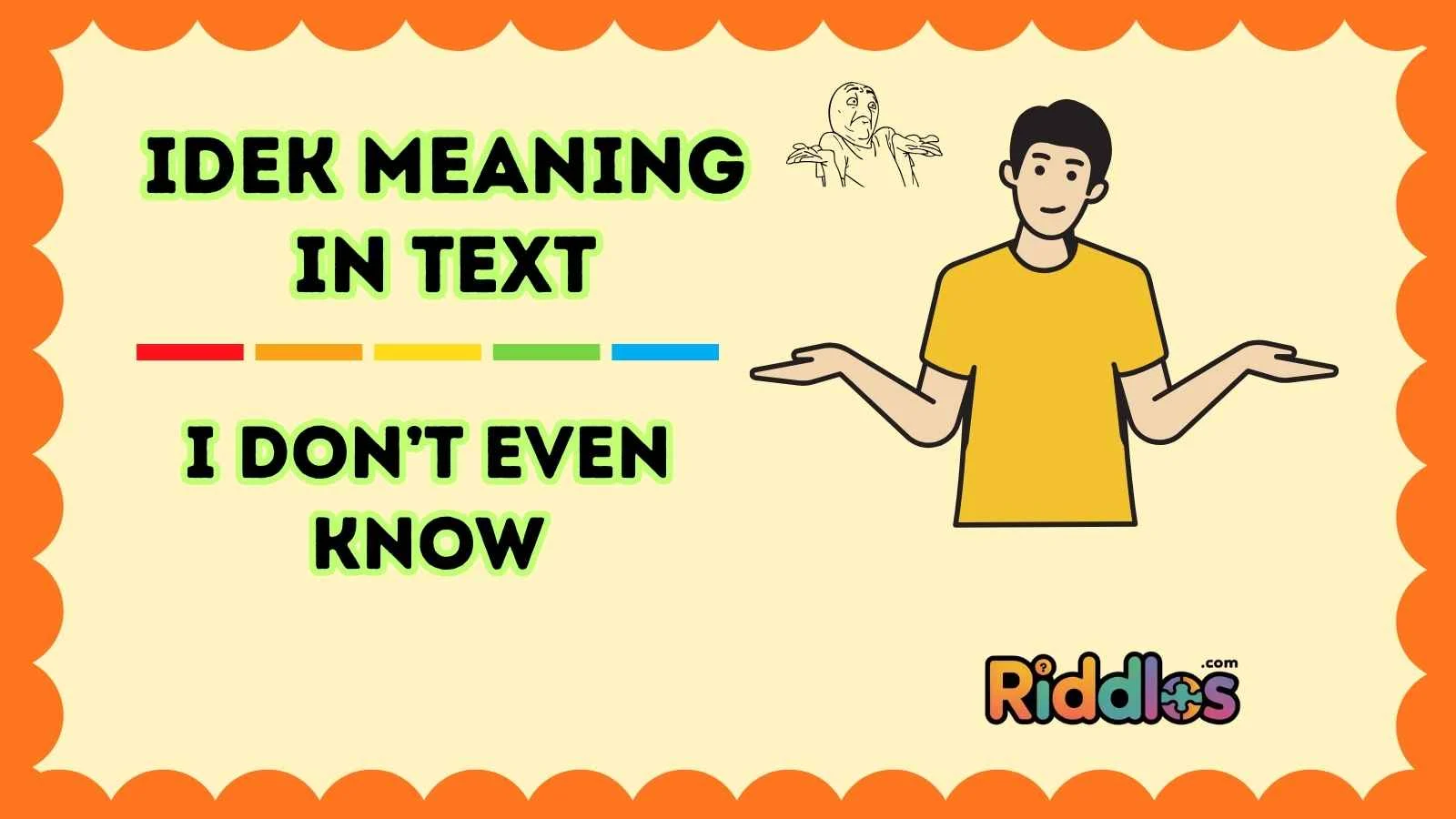
IDEK stands for “I don’t even know.”
People use it when they feel uncertain, confused, shocked, amused, or overwhelmed.
Sometimes it expresses mild annoyance. Other times it shows disbelief or humor. Because tone shifts with context, the meaning depends on the conversation.
Core idea
IDEK conveys a stronger emotional punch than IDK.
IDK might sound neutral.
IDEK adds intensity.
Breakdown of the acronym
| Letter | Meaning |
|---|---|
| I | I |
| D | Don’t |
| E | Even |
| K | Know |
Quick examples
- Someone tells a chaotic story and a friend replies idek to show disbelief.
- A person forgets something and says idek why I said that.
- Someone laughs at their own confusion and writes idek anymore 😂.
Origin and Evolution of IDEK
IDEK traveled through several phases of online culture.
Early forums used it casually.
AIM chats and MySpace brought it into mainstream internet slang. Social networks fuelled its popularity. TikTok and Instagram Reels revived it for a new generation.
Why IDEK grew popular
- Easy to type
- Fits short texting rhythm
- Adds emotional layering
- Works for humor and frustration
- Blends into sarcasm
Timeline snapshot
| Year | Cultural Moment | Impact |
|---|---|---|
| Early 2000s | Chatrooms, AIM, MSN | IDEK becomes part of teen slang |
| 2010–2015 | Tumblr, Twitter | Sarcastic IDEK memes spread |
| 2020–2025 | TikTok, Reels, Snapchat | IDEK resurges among Gen Z |
IDEK in Real Conversations
Seeing IDEK in real sentences helps clarify its tone. Below are examples modeled after actual communication styles across digital platforms.
Casual texting
- “idek why I’m still awake”
- “idek what to eat lol”
- “this day is wild idek”
Social media
- “idek what this trend is supposed to be 😂”
- “idek how some of y’all drive like that”
- “idek anymore this app stays messy”
Group chats
- “We planned for 5 people now 22 showed up idek”
- “idek what the plan is someone decide”
- “idek why my WiFi hates me today”
Meaningful situations
- Confusion
- Comedy
- Tiredness
- Helplessness
- Mild frustration
In short, IDEK works as a flexible emotional shorthand.
IDEK Meaning in Text Across Different Contexts
Texting uses IDEK to express quick, emotional reactions.
The acronym softens awkward moments. It adds humor when someone feels lost or surprised.
How it sounds
- Casual
- Relatable
- Lightly dramatic
- Sometimes playful
Common intentions
- “I truly don’t understand this.”
- “Life is too chaotic right now.”
- “This makes no sense and I’m laughing at it.”
IDEK also pairs naturally with emojis.
For example:
idek anymore 🤦♂️
idek why this is funny 😂
IDEK in Gaming Chats
Gamers love fast shorthand. IDEK shows up when a player cannot explain a situation mid-game.
Common gaming uses
- After a random glitch
- When a teammate acts unpredictably
- When someone loses unexpectedly
Examples
- “Bro idek what that boss just did”
- “idek how we survived that round”
- “idek why the lag is so bad today”
In gaming, IDEK rarely carries negativity. It usually expresses chaotic fun.
IDEK in Dating Apps (Tinder, Bumble, Hinge)
IDEK appears in playful or awkward chats.
Dating app messages often use it to lighten the mood.
What IDEK signals on dating apps
- Nervous humor
- Flirting with a “cute confusion” vibe
- Trying not to sound too serious
- Showing personality
Examples
- “idek how I matched with someone this cool”
- “idek what to say but hi 👀”
- “idek why this app thinks we’re a match lol”
Tone matters because people judge vibes quickly. IDEK feels relaxed which helps keep conversations friendly.
IDEK in School or Work Communication
People sometimes use IDEK in school chats or internal workplace messages. Informal environments usually tolerate it. However, professional settings require balance.
When IDEK is acceptable
- Friendly team chats
- Student group work
- Close coworker discussions
- Casual Slack channels
When to avoid IDEK
- Client communication
- Formal presentations
- Résumés
- Emails to supervisors
IDEK may sound unprofessional in structured environments. A safer alternative might be:
“I’m not sure yet.”
or
“I don’t have the answer at the moment.”
Common Misinterpretations of IDEK
Many misunderstand IDEK because tone varies across cultures and personalities.
Misinterpretation list
- People confuse IDK and IDEK
- Some think it sounds angry
- Others hear sarcasm even when none exists
- Non-native speakers assume it’s rude
- Some read it as giving up completely
How misreading happens
A single message like “idek anymore” can express exhaustion or humor. Without emojis or context the meaning shifts.
Preventing confusion
- Read the surrounding conversation
- Look for emojis that soften the tone
- Check the person’s usual texting style
Is IDEK Ever Offensive?
IDEK is not inherently offensive.
Tone dictates whether it feels harsh or dismissive.
Situations where IDEK might seem rude
- Responding with IDEK when someone asks a serious question
- Using IDEK to shut down a conversation
- Saying IDEK during a conflict where clarity is expected
Neutral or harmless uses
- Conversations about silly topics
- Shared confusion
- Group chat jokes
- Reaction to chaotic events
How to avoid negative tone
- Add an emoji
- Add context
- Keep the message light
Regional and Cultural Differences
IDEK meaning stays mostly consistent worldwide yet usage varies depending on culture and online community.
US
- Extremely common
- Often used humorously
- Paired with memes or GIFs
UK
- Used less dramatically
- Often typed without emojis
Canada & Australia
- Similar to US tone
- Frequently seen in gaming chats
International learners
- Some avoid IDEK due to confusion
- Many learn it from TikTok
- Misinterpretation happens when tone feels too intense
Social media subcultures
| Online Space | Frequency | Typical Tone |
|---|---|---|
| TikTok comments | High | Dramatic, humorous |
| Twitter/X | High | Sarcastic, short-form |
| Medium | Playful | |
| Medium | Analytical or comedic | |
| Discord | Very high | Gaming chaos |
How to Respond When Someone Says “IDEK”
Tone matters when replying. Below are practical categories with example responses.
Friendly responses
- “Same honestly.”
- “Wild day huh.”
- “That’s a mood.”
Clarifying responses
- “Want me to explain it?”
- “Should we figure it out together?”
- “What part doesn’t make sense?”
Playful or flirty responses
- “IDEK either but I like where this is going.”
- “IDEK why you’re cute but here we are.”
- “IDEK plus your message made me smile.”
When IDEK signals frustration
- “You good?”
- “Want to talk about it?”
- “Take a breather we got this.”
Responses to avoid
- “?”
- “What.”
- Short replies that feel cold
A good rule is to match their tone, not mirror their confusion.
Related Acronyms and Alternatives
Many acronyms appear next to IDEK. A comparison helps distinguish them.
Direct alternatives
- IDK – “I don’t know”
- IDC – “I don’t care”
- IDGAF – Stronger, often rude
Emotional alternatives
- OMG – Shock
- FR – Agreement
- LMAO – Humor
Comparison table
| Acronym | Meaning | Emotional Level | Appropriate Situations |
|---|---|---|---|
| IDEK | I don’t even know | Mild–Medium | Confusion, chaos, humor |
| IDK | I don’t know | Neutral | Asking questions, simple confusion |
| IDC | I don’t care | Dismissive | Ending a debate, low interest |
| IDGAF | I don’t give a **** | Strong | Intense emotions, arguments |
Understanding tone difference improves communication.
IDEK in Professional Settings
IDEK rarely fits formal settings.
Workplaces value clarity and tone control. Slang may feel unprofessional.
Acceptable Uses
- Team Discord chats
- Office group chats with friendly culture
- Internal brainstorming
- Casual Slack updates
Not acceptable
- Communication with stakeholders
- HR messages
- Press releases
- Emails to clients
Professional alternatives
- “I’m not sure yet.”
- “I need clarification.”
- “Let me check and get back to you.”
- “The situation is unclear at the moment.”
Maintaining professionalism protects credibility.
Is IDEK Slang or an Acronym?
IDEK is both.
It’s an acronym formed from the first letters of a phrase yet it also behaves like slang because users apply emotional meaning beyond the literal definition.
Is IDEK Still Popular in 2025?
Yes.
IDEK remains heavily used across all major platforms.
Evidence from digital behavior
- TikTok captions use it frequently
- Snapchat stories include it often
- Gaming streams show IDEK spam in chats
- Instagram comment sections rely on dramatic slang
Its popularity remains stable because of its emotional versatility.
Why Do Teens Use IDEK So Often?
Teen communication thrives on shorthand. IDEK expresses mood quickly without overexplaining feelings.
Reasons teens prefer IDEK
- Quick expression
- Flexible tone
- Relatable slang
- Works with memes
- Reduces awkward moments
Teenagers often use IDEK during moments of confusion or during funny randomness.
FAQs:
What does IDEK mean in text?
IDEK means I don’t even know. It expresses confusion, disbelief, or emotional overwhelm.
Is IDEK the same as IDK?
No. IDK sounds neutral. IDEK adds emotional impact.
Is IDEK rude?
Not usually. It only sounds rude when used in serious or sensitive conversations.
Can you use IDEK at work?
Only in informal team chats. It feels unprofessional in formal communication.
How do you reply to IDEK?
Match the tone. Clarify, joke back, or show support depending on the situation.
Conclusion:
IDEK meaning in text feels simple on the surface. Yet the acronym carries layers of tone and emotion depending on the conversation.
It signals confusion, humor, disbelief, and sometimes exhaustion. It slides naturally into social media posts, gaming chats, or casual texting. Understanding the user’s intention helps avoid miscommunication.
People worldwide continue using IDEK because it captures the chaotic energy of modern communication.
Whether someone feels stressed, amused, or speechless, IDEK wraps those emotions into an easy, relatable shorthand.
Mastering slang like this strengthens digital communication and improves clarity across conversations.